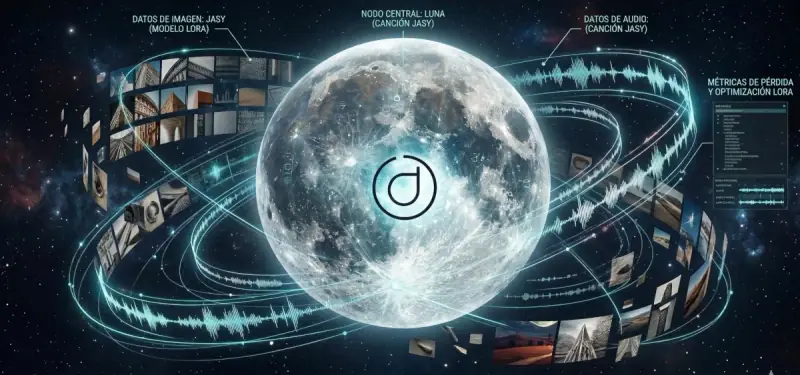
Generative AI
AI video engineering: modulation architecture and rhythmic synchronisation
A technical analysis of AI video architecture: rhythmic synchronisation through audio reactivity and modulations for professional workflows.
Published updated 3 min read
Automated visual content production has evolved towards a parametric control model in which mathematical precision replaces manual editing. At Oksigenia, we analyse the infrastructure of Neural Frames, a platform that lets you orchestrate animations through modulation systems similar to professional audio production environments (DAWs).
1. Modelling animation through oscillatory modulation
Dynamic control of the artificial intelligence's parameters is based on wave functions that define how values are interpolated over time. The system's architecture lets you set the frequency of these cycles in hertz (Hz), where 1 Hz equals one complete cycle per second.
The amplitude logic applied varies according to the geometry of the selected wave:
- binary alternation (square): produces immediate rhythmic cuts between two states, with no transition.
- ramp modulation (sawtooth): used for effects of linear rise or fall in intensity.
- pulse states (pulse): unlike the previous ones, this wave operates within a unidirectional range of original value ± amplitude, which makes it possible to highlight specific rhythmic events without altering the original base.
2. Audio reactivity through signal extraction (stem extraction)
The real power of the platform lies in its ability to break a complex audio signal down into its fundamental components using neural networks. Instead of an overall volume analysis, the system lets you map modulations to 8 independent frequency channels:
- percussion and transients: dedicated channels for kick, snare, toms and hihats.
- harmony and melody: extraction of low frequencies (bass) and vocal components.
- residual analysis (other): captures sound textures that do not fit into the standard categories.
This source separation ensures that the visual transformation is tied to the actual structure of the music, so that a change in zoom responds only to the kick drum, while the camera rotation follows the vocal line.
# oksigenia-it: rhythmic modulation profile v1.0
modulation_profile:
  target: "strength"          # AI strength parameter
  source: "stem_kick"         # analysed kick drum frequency
  mapping:
    min_value: 0.60           # visual stability threshold
    max_value: 0.85           # rhythmic transformation peak
    interpolation: "sine"     # smooth transition curve
  sync:
    bpm_lock: true            # mathematical sync with the tempo
    fps_base: 25              # Oksigenia production standard
3. Temporal synchronisation and frame infrastructure
To guarantee visual stability and avoid flicker (flickering), the platform synchronises the generation rate with the tempo of the piece (BPM). This relationship is governed by the following technical logic:
In a standard production environment at 25 FPS, a track at 60 BPM completes an animation cycle every 25 frames exactly. This precision is vital for professional export, especially when using external models (such as Runway or Kling) that run at 24 FPS, which require the frame calculation to be adjusted automatically to maintain rhythmic coherence.
4. Optimising the visual transformation
Oksigenia's technical consultancy recommends strict control of the strength parameter to preserve image integrity. According to the operating manuals:
- optimal range: keeping the modulation between 0.60 and 0.80 prevents colour degradation and loss of detail.
- spatial transformations: the ability to modulate the Z axis (zoom) and the three rotation axes independently makes it possible to create a sense of three-dimensional depth in a two-dimensional latent diffusion environment.
True innovation in the use of artificial intelligence lies not in the automatic generation of images, but in the technical ability to subject the algorithm to a predefined rhythmic and architectural logic.

Implementation analysis for Oksigenia
This level of parametric control allows Oksigenia to offer visual scalability solutions for companies seeking a unique identity. By mastering granular audio reactivity and BPM synchronisation, we can ensure that every second of animation is backed by solid mathematical logic, guaranteeing stability and professionalism in every delivery.
If you want to create music videos, experiment with our partner Neural Frames.