Security
The digital blackout: who really holds the key to your business?
Don't let your company depend on a single switch. Learn the difference between sales channels and digital sovereignty with Oksigenia's managed solutions.
Published updated 3 min read

In the age of “everything as a service”, we have accepted a silent vulnerability. Many business owners believe their digital infrastructure is solid because they pay a tech giant, when in reality what they have done is hand their survival over to a switch they do not control.
At Oksigenia, we manage advanced digital services and run our own retail line on large marketplaces. This dual role lets us speak with authority: we know you have to be where the customers are, but also that your operations cannot be held hostage by the platform.
“Digital sovereignty is not about cutting yourself off from the world, but about making sure the foundations of your house do not depend on an algorithm that has no customer service phone line.”
Andrew Spinks vs. the algorithm
In 2021, Andrew Spinks, the developer behind the hit game Terraria, saw Google disable his corporate account without any prior warning or explanation.
Overnight, he lost access to his Gmail (with years of business contacts), his documents on Drive and the whole ecosystem linked to them. He spent three weeks trying to speak to a human being at Google, without success. The impact was such that Spinks announced he was cancelling the release of his game on Google's platform (Stadia) as the only way to apply pressure.
If this happens to a millionaire business partner, what chance does an SME have when a bot decides to block its access because of a detection error?
// The architecture of extreme risk:
while (business_running) {
    if (third_party_algorithm.says("NO")) {
        access = 0;
        support_response = "automatic_email_in_48h";
        panic_level = 100;
    }
}
Sales channels vs. vital infrastructure
This is where we need to be strategic. At Oksigenia we are realistic: we operate on Amazon and other global channels because that is where the sales volume is for our general merchandise line (which covers everything from fashion to homeware and assorted goods). However, we apply a strict technical separation: the marketplace is our shop window, but never our office.
- Sales (retail): We use external platforms to reach the public. It is a calculated and necessary risk.
- Brain and operations (digital services): Our corporate website, our order management systems, our Moodle training environments, our databases and our n8n automations are self-hosted on our own infrastructure, managed with Docker.
If a sales channel decides to change its terms or blocks us by mistake, we lose revenue temporarily, but we do not lose the business. Our data, our processes and our ability to communicate remain intact, so we can keep operating through other channels.
The Oksigenia proposal: strategic independence
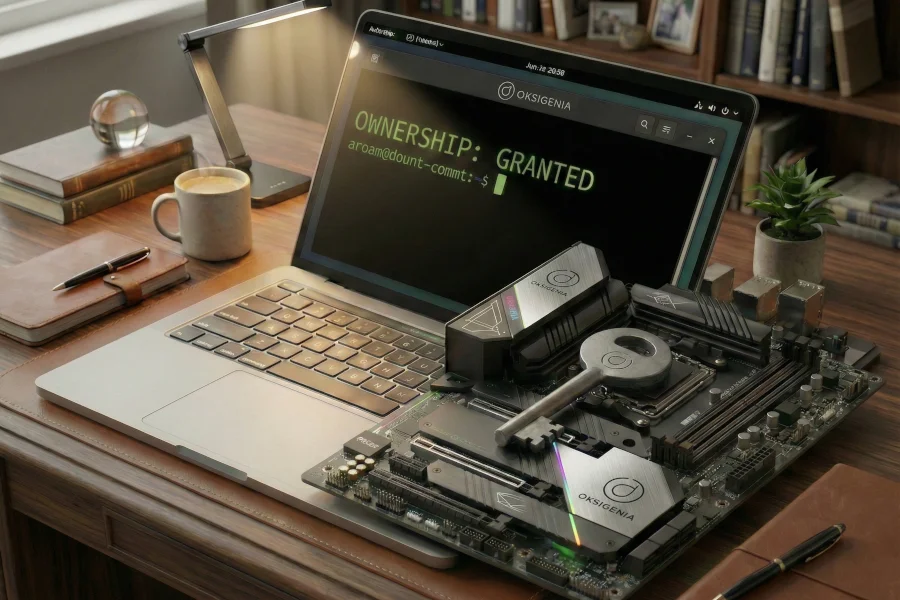
Our consultancy service is not about having you live apart from the giants, but about making sure you do not depend on them to breathe. We propose a model in which the “core” of your company is sovereign:
- Dockerised infrastructure: Total portability. If the physical server fails, we move your work “containers” to another node in our network within minutes.
- Critical systems of your own: Your invoicing, your CRM and your training platforms (Moodle) must run under your control, not under a closed subscription that can shut you out without any human intervention.
- Security and privacy: We implement solutions such as Proton to ensure that your business communications are private and do not depend on the arbitrary policies of Big Tech.
# Checking your resilience at Oksigenia:
$ oksigenia-status --check-sovereignty
> Infrastructure: SELF-HOSTED [OK]
> Identity Control: PRIVATE [OK]
> Dependency Risk: DECOUPLED [OK]
Don't let the heart of your business be someone else's sub-account. At Oksigenia we help you build a structure in which you, and only you, hold the master key.